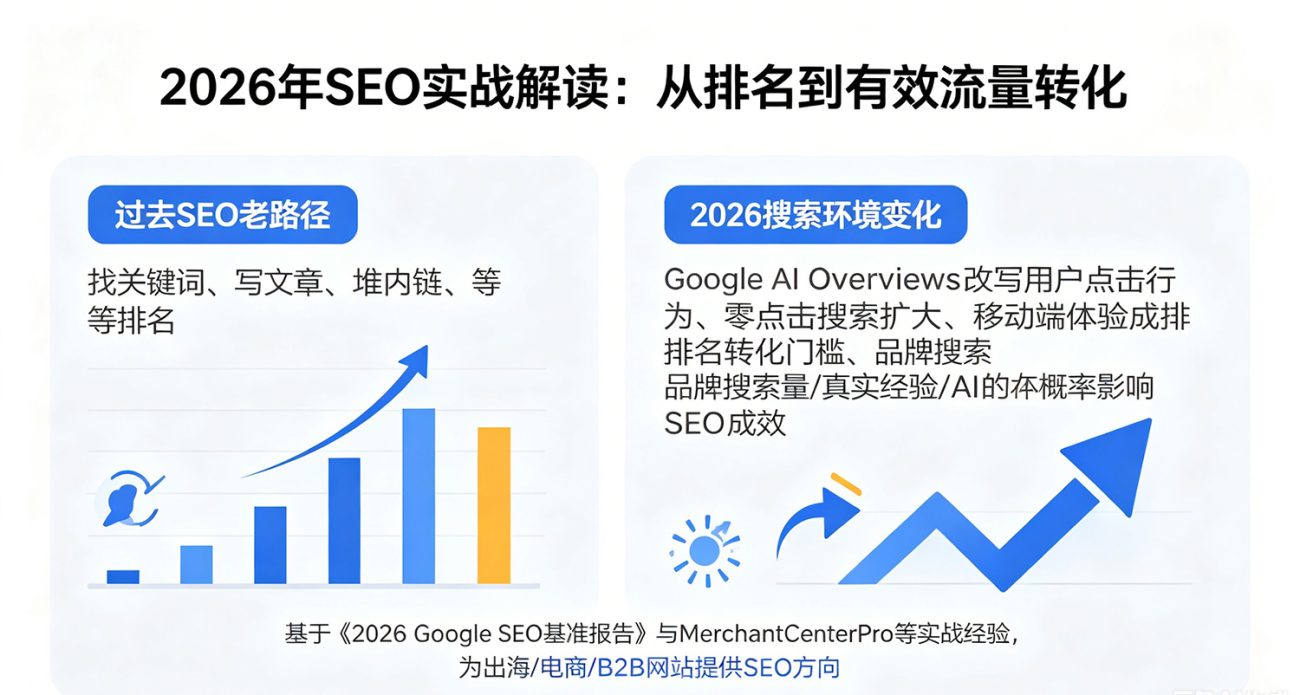
For the past few years, many websites have approached SEO the old way: “find keywords, write articles, stack internal links, wait for rankings.” But the search environment in 2026 has changed. Google AI Overviews are rewriting how users click, zero-click searches keep growing, mobile experience has become a shared threshold for both rankings and conversions, and brand search volume, first-hand experience and the likelihood of being cited by AI are playing an ever bigger part in SEO results.
This article is based on public industry data compiled in the “2026 Google SEO Benchmark Report”, combined with MerchantCenterPro’s day-to-day experience on ecommerce websites, Google Merchant Center and Google Ads projects, and offers a more practical reading. It is not just a list of figures. It answers a more realistic question: if you run a cross-border website, an ecommerce website or a B2B business website today, how should you do SEO in 2026 so that you do not end up with rankings but no useful traffic or conversions?
1. The biggest SEO change in 2026: search volume is still there, but the click logic has changed
The most noteworthy point in the report is that Google search volume is still very high, but the relationship between “search demand” and “website visits” is being restructured. In the past, if a keyword ranked near the top, traffic would almost certainly grow with it. Now AI Overviews, featured snippets, local map packs, knowledge panels and other SERP features satisfy part of the demand directly on the results page.
That is why the report notes that zero-click searches reach 60%-65% of Google searches in 2026, and as high as 77% on mobile. This does not mean SEO is useless; it means the way SEO is evaluated has to be upgraded. If you only look at organic clicks, it is easy to misjudge how your website is doing. A page may gain impressions, increase brand exposure and be cited in AI summaries while clicks do not rise in step. Conversely, a page may get decent clicks in the short term simply because its queries are not yet covered by AIO.
In day-to-day operations, I recommend splitting SEO metrics into four groups. First, rankings and impressions, to judge whether your content enters the pool of search candidates. Second, click-through rate and organic visits, to judge whether the page can still attract users to your site. Third, conversion rate and lead quality, to judge whether the traffic has commercial value. Fourth, brand search volume and AI citations, to judge whether your website is building longer-term visibility.
2. CTR benchmarks can no longer be copied as-is: look at AIO and non-AIO queries separately
| Search result scenario | Key figure in the report | Impact on SEO judgment |
|---|---|---|
| Clean SERP | The top 3 positions take about 68.7% of all clicks | Traditional rankings still matter, especially for commercial-intent keywords |
| Position 1 organic result | Gets more clicks than positions 3-10 combined | Top rankings are still high-value assets |
| AI Overview present | Position 1 CTR can fall by more than 50% | For informational keywords, look at citations and visibility, not just clicks |
| Brand keywords | CTR is usually above 30%-40% | Brand search should be analyzed separately and not mixed with non-brand keywords |
| Non-brand keywords | Top positions commonly see a CTR of about 5%-10% | Better suited to evaluating new customer acquisition |
The report notes that in a clean SERP, the top 3 positions take about 68.7% of all clicks, and position 1 alone gets more clicks than positions 3-10 combined. This shows that traditional rankings still matter. But the same report also points out that when an AI Overview appears, the CTR of the first organic result can fall by more than 50%. These two conclusions do not contradict each other; they show that search result pages have now split into two types of scenarios.
High-AIO-coverage queries: the goal is to become the source of the cited answer
Informational queries are the most likely to trigger an AI Overview, for example “what is Core Web Vitals”, “how to set a Google Ads budget” or “what are SEO conversion rate benchmarks”. Even if you rank first for this kind of query, the AI summary can take away a large share of the clicks. So content strategy cannot be designed only around “attracting clicks”; you also have to think about how to become a trusted source that AI can cite.
Content that gets cited more often usually shares a few traits: a clear structure with explicit subheadings; specific data, steps or comparisons; accurate explanations of concepts; first-hand experience or industry judgment; and good visibility in traditional Google search. The report notes that 76.10% of pages cited by AIO also rank in Google’s top 10, which shows that traditional SEO is still the foundation of AI search visibility.
Low-AIO-coverage queries: the goal is still to win clicks and conversions
Transactional, navigational and long-tail queries are affected relatively less by AIO. For example, when users search for a specific tool, a service price, a product solution or a merchant review problem, they usually still need to visit a website to learn more. These keywords should keep being optimized with the traditional SEO approach: make titles more compelling, strengthen page relevance, add trust elements and optimize the conversion path.
If you run an ecommerce or Google Shopping business, see our article 2025 Google Shopping Ads Guide and combine the demand captured by SEO with follow-up ad campaigns and product data optimization, instead of treating organic and paid traffic separately.
3. Conversion rate matters more than traffic: organic search is still a high-value channel
| Traffic or scenario | Benchmark in the report | Operational meaning |
|---|---|---|
| Organic search | Still contributes about 53% of total website traffic | SEO is still the main long-term customer acquisition channel |
| AI search traffic | Conversion rate of about 3.49%, 22% higher than traditional organic search | Channels such as ChatGPT and Perplexity need to be tracked separately |
| ChatGPT ecommerce traffic | Conversion rate of about 1.81%, 31% higher than non-brand organic search | Users who arrive after an AI recommendation often have stronger decision intent |
| Desktop | Conversion rate of about 3.5%-4.0% | Still suited to complex decisions and high-ticket conversions |
| Mobile | Conversion rate of about 1.8%-2.5% | Speed, forms and the payment path need focused optimization |
Many people see the rising zero-click share and jump to the conclusion that “SEO traffic will disappear”. That judgment is too crude. The report also points out that organic search still contributes 53% of total website traffic, far more than paid search, social and direct visits. On B2B websites, organic plus paid search contribute more than 75% of traffic. This means the question for SEO is not “whether to do it” but “how to do it so it produces business results”.
When judging SEO results in 2026, you cannot just ask “how many visits did this article bring?” Ask instead: are the users it brings closer to a purchase decision? Does it increase brand search? Does it bring users into the remarketing pool? Does it support Google Ads or Shopping Ads conversions? For ecommerce websites, SEO pages should also help educate users, explain policies, reduce doubts and build trust.
For example, if a website is dealing with Google Merchant Center product review or product data quality issues, a generic article on “what is GMC” has limited value. More valuable content discusses product feeds, policy compliance, landing page trust and ad conversion together. See our article How to Optimize Google Merchant Center Product Data. Content like this is closer to what users actually do at work and also fits the “Experience” requirement in E-E-A-T better.
4. The core of E-E-A-T is not posing as an authority, but providing verifiable experience
The report notes that Google’s Helpful Content system has been integrated into the core algorithm, and large amounts of undifferentiated AI-generated content are becoming an SEO liability. This is critical. Many websites assume that E-E-A-T means writing “we are professional” or “we have years of experience” in their articles, but that does not actually build trust.
A more effective approach is to let the content itself demonstrate experience. For example, when writing about SEO benchmarks, do not just say “improve content quality”. Explain which content will be eaten up by AIO and which content is still worth a user’s click. Do not just say “backlinks are important”. Explain why topically relevant links with real traffic are more valuable than links from a high-DR site nobody visits. Do not just say “improve speed”. Be specific about how LCP, INP, image size and mobile experience affect rankings and conversions.
The report has a conclusion that is very practical to act on: content length is not a ranking factor; topical completeness is what matters. Average content on Google first-page results is about 1,447 words, and the top 3 results for highly competitive keywords average 2,000-2,500 words. But what makes long content perform better is that it covers the question more completely and earns more backlinks and shares. A 10,000-word article that drifts off topic, repeats itself and adds no real information can actually hurt page quality.
5. Backlink strategy is moving from “authority worship” to “real traffic and relevance”
Backlinks still matter. The report notes that the first-ranked result has on average 3.8 times as many backlinks as results in positions 2-10, and more than 90% of top-10 pages have at least 1 referring domain. But in 2026, link building cannot look only at DR or DA. A link from a DR70 site with no real traffic is not necessarily more valuable than a link from a DR25 industry blog with 5,000 monthly visits and a highly relevant topic.
This is especially important for small and medium websites. Many new sites have limited budgets and cannot get large numbers of high-authority media links at the start. A more realistic path is to first build long-tail topics and citable content, accumulating real cases, tools, pricing analyses, data tables and answers to industry questions, and then earn relevant links through partnerships, PR, industry resources and client case studies. Backlinks should not be isolated “authority” bought in, but the result of your content’s value being recognized by the industry.
If your website’s goal is lead generation, backlinks also need to serve brand signals. The report notes that the correlation between brand search volume and rankings has already surpassed the correlation between DA and rankings. In other words, Google is getting better at recognizing whether a brand is really remembered, searched for and discussed by users. SEO, PR, social content, customer reviews and offline industry events all indirectly affect search performance.
6. Mobile and Core Web Vitals: in 2026 they can no longer be treated as technical details
| Metric | Recommended 2026 benchmark | Risk noted in the report | Priority optimization direction |
|---|---|---|---|
| LCP | ≤ 2.0 seconds | Sites with LCP over 2.5 seconds may drop 2-4 positions on average | Compress above-the-fold images, reduce blocking scripts, improve server response |
| INP | ≤ 200ms | Sites with INP over 200ms drop about 0.8 positions on average | Reduce long tasks, optimize JS, limit the impact of third-party scripts |
| CLS | Keep the layout stable | Poor mobile experience directly affects trust and conversion | Reserve space for images/ads and avoid dynamic content pushing elements around |
| Image size | Use WebP and lazy loading wherever possible | Images can account for 78% of total page weight | Compress images, set up responsive images, remove unnecessary large images |
The report notes that in 2026 the “good” LCP threshold tightens from 2.5 seconds to 2.0 seconds, and INP has also become a core ranking signal. The more realistic problem is that many websites look fine on desktop but load slowly on mobile, with heavy images and laggy interactions. For ecommerce websites this affects not only rankings but also sales directly.
Images are usually the biggest bottleneck. The report notes that images can account for 78% of total page weight, and the average page has 21 images totaling about 1.9MB. The highest-priority optimizations are actually not complicated: compress images, use WebP, enable lazy loading, avoid loading too many unrelated scripts above the fold, and reduce layout shift on mobile. Especially on product pages, collection pages and blog pages, if images have no declared dimensions or are loaded repeatedly by the theme, both CLS and LCP will suffer.
Our article on Google marketing tools also notes that SEO, Google Ads, Merchant Center, Analytics and Search Console cannot be viewed separately. Truly effective growth work analyzes search visibility, ad data, product data and conversion data together.
7. 2026 SEO action checklist: from a traffic mindset to a value mindset
| Priority | What to do | Why it matters | Suggested metrics to watch |
|---|---|---|---|
| High | Separate brand and non-brand keywords | Prevents brand keywords from masking real customer acquisition ability | Brand search volume, non-brand impressions, non-brand conversions |
| High | Optimize mobile CWV | Mobile has high zero-click rates and more fragile conversion, so poor experience amplifies losses | LCP, INP, CLS, mobile conversion rate |
| High | Update old content ranking in positions 4-15 | The report shows organic traffic rises 106% on average after old content is optimized | Ranking changes, CTR, leads/orders |
| Medium | Build structured content for AIO queries | AIO reduces clicks but can raise brand visibility and citation opportunities | AIO citations, impressions, brand search growth |
| Medium | Build relevant backlinks with real traffic | Backlink value is shifting from authority to relevance and real visits | Referring domains, traffic of linking pages, topical relevance |
If I had to sum up the change in SEO in 2026 in one sentence, it would be this: stop treating SEO as pure ranking engineering and treat it as an integrated system of search visibility, brand trust and conversion efficiency.
1. Separate brand and non-brand keywords
Brand keywords usually have a high CTR and conversion rate, but they mostly reflect that users already know you. Non-brand keywords make up most of organic search and are the source of new customers. The two must be viewed separately. Otherwise brand keywords will “beautify” your data and make you think overall SEO performance is good.
2. Build a dual-track strategy for AIO and non-AIO queries
For high-AIO-coverage queries, create structured, trustworthy content that is easy to cite. For low-AIO-coverage queries, keep fighting for clicks and conversions. The former is more like brand exposure and authority building, and the latter is more like traffic and lead acquisition.
3. Update old content first
The report notes that organic traffic rises 106% on average after old content is optimized, and leads can even double. Prioritizing pages that have declined for 3 consecutive months, rank in positions 4-15, or already have impressions but too few clicks is usually more worthwhile than blindly adding new articles.
4. Content must add real information
Do not mass-produce templated “definition + benefits + methods” articles. Better content includes cases, data, price ranges, operating steps, lessons from failures, tool lists and decision criteria. For DTC or ecommerce websites, you can combine this with DTC Website Promotion Strategy and design SEO content together with the conversion path.
5. Treat mobile performance as SEO infrastructure
Mobile contributes most of the traffic but often converts lower. LCP, INP and CLS are not just technical metrics. They affect whether users keep browsing, whether they trust the website, and whether they complete a purchase or submit a form.
Conclusion: in 2026, the goal of SEO is not more pages, but being more worth choosing
Google SEO in 2026 is no longer suited to a crude approach of “write more articles, build more backlinks, stuff more keywords”. AI Overviews and zero-click searches take away some shallow clicks, but they also amplify websites that are truly trustworthy, clearly structured, experienced and have brand signals. Traditional SEO has not disappeared; the bar has just been raised.
For merchants, the most practical direction is: use data to judge opportunities, use experience to make content credible, use technical performance to reduce drop-off, use brand building to raise search trust, and then use internal links and conversion paths to turn traffic into business results. Websites that do this will not depend on a single ranking position to survive, even in the age of AI search.